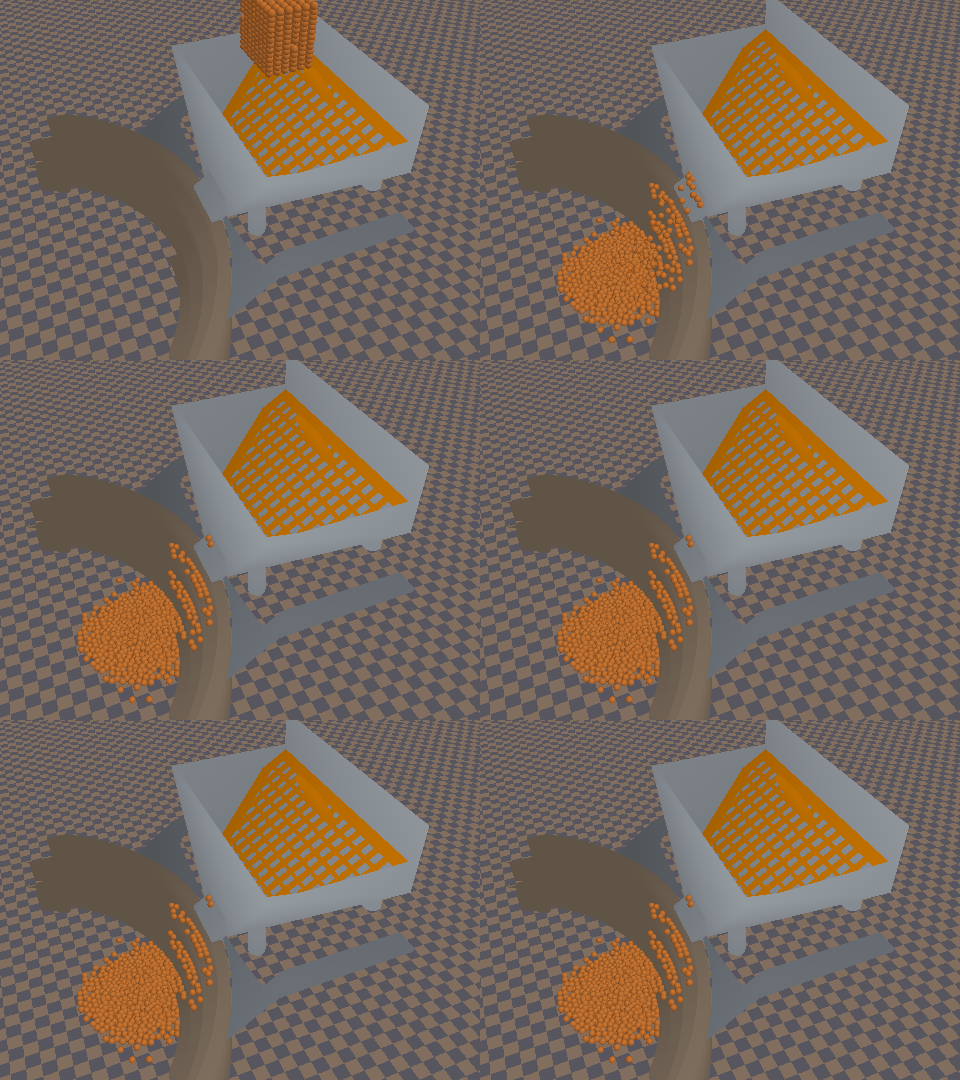
The hopper from part 3 looked right, but I wanted to know if it would actually work: do the lentils fall through the grate and slide back into the pit, and do the gems stay? So Bench's model scripts can now run a physics simulation. Here's a bucketful dropped onto the grate, at half speed:
How it works
The simulation uses PyBullet, a physics engine for Python, and the real Hopper 1 parts as they're modelled: the bin, the grate, the aprons, and the rim with its spillway notch. A full bucket is about 600 lentils and a few gems:
- Lentils are flat lenses, 5 mm across and 2.4 mm thick, so they slide rather than roll.
- Gems are 11 mm glass beads, so they roll.
The load falls from the height where the bucket opens. After a few simulated seconds, the script counts where everything ended up. One run takes about five minutes on my Mac.
The friction numbers are guesses: lentil on PLA, glass on PLA. The real answers will come from two cheap prints, a square of the grate and a plate at the floor's 32° slope. But the simulation shows whether the shape works at all, and it found a problem.
What it found
In the first run, only 73% of the lentils got back to the pit. The rest were stuck on the grate. The grate slopes, so everything slides to its low end, and the lentils that got there jammed between the grate's solid bottom edge and the bin's wall. There was no hole under them.
The fix is a slot. The grate now stops 7.5 mm short of that wall. A 5 mm lentil drops through the gap, and an 11 mm gem can't. The gems end up in a neat row at the grate's low end, easy to lift out and count.
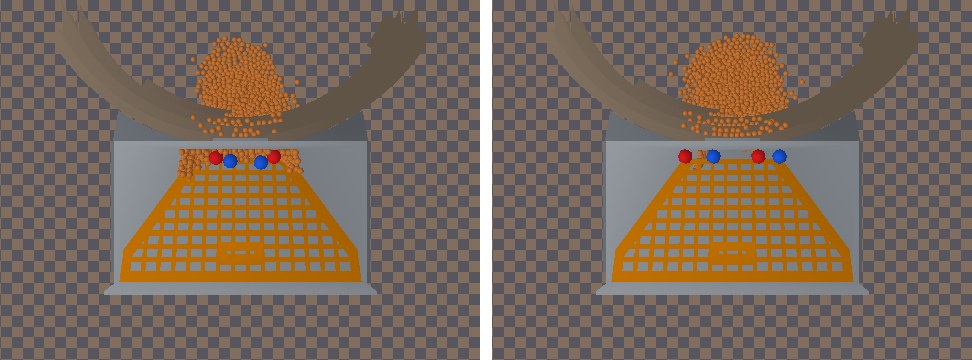
| Run | Lentils back in the pit | Left in the bin | Gems on the grate |
|---|---|---|---|
| The grate as first designed | 73% | 27%, jammed at the grate's low end | 4 of 4 |
| With the slot | 97% | 3% on the floor under the grate | 4 of 4 |
| With the slot, stickier lentils | 99% | 1% | 4 of 4 |
| With the slot, too sticky to slide on 32° | 92% | 7% | 4 of 4 |
In every run, nothing landed on the board outside the pit. The spillway notch empties the bin in about a second.
What I learned
- Simulate before printing. A five-minute simulation found a problem I'd only have seen after printing a 120 cm³ bin.
- Look where the pieces end up, not just the totals. "27% on the grate" didn't say why. The top view showed them packed against the wall.
- Test the guesses too. Running it with stickier lentils showed the hopper still works if my friction numbers are wrong.
Comments (0)